
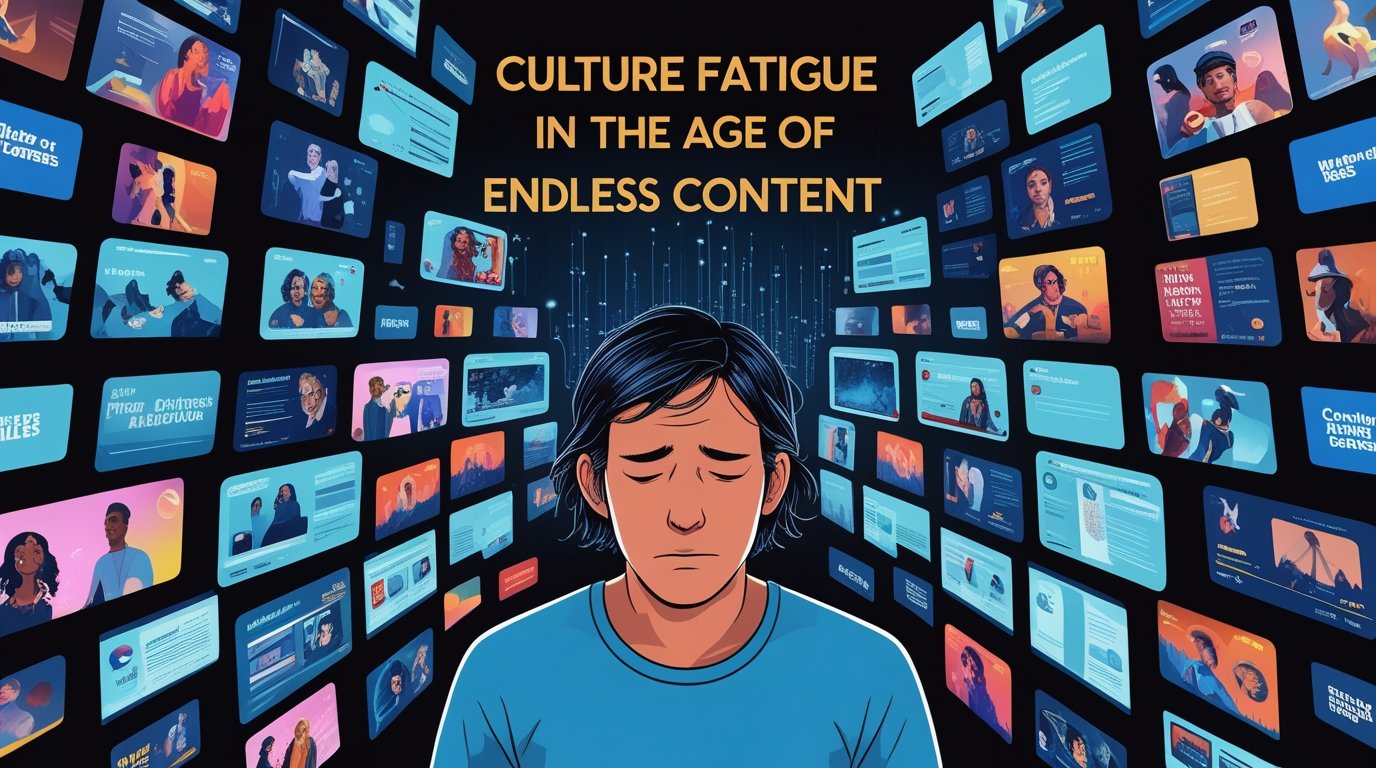
I can pinpoint the moment I broke. It was a Tuesday night. I was horizontal on my couch, phone in hand, engaged in what I can only describe as cultural multi-threading. On the TV, a critically acclaimed prestige drama was paused mid-scene. On my tablet, a YouTube essay about the socio-political subtext of that very drama played on mute. On my phone, I was scrolling through Twitter, ohh sorry it’s now known as X thread, where people were arguing about the essayist’s take, while also keeping one eye on a group chat where we were supposedly “watching” a new reality show. I wasn’t consuming culture. I was conducting a frantic, joyless triage of it. My head felt like a browser with 47 tabs open, all of them playing different audio. I was drowning in a sea of content, parched for any drop of genuine experience. This is the story of my culture fatigue, not burnout from work, but burnout from the very things meant to fill my leisure time, and how I’m slowly, painfully, learning to swim to shore.
The Infinite Buffet and the Shrinking Appetite:
The shift was insidious. It wasn’t that one day I had three TV channels and the next I had Netflix. It was the layer-caking of access. First, the streaming services, each a walled garden of “must-see” originals. Then, the podcasts, a universe of conversations I felt behind on. The newsletters, promising to distill it all for me. The TikTok and Instagram feeds are turning cultural analysis into a 60-second sugar rush. The “watchlist” or “read later” list stopped being a helpful reminder and became a guilt-laden ledger, a to-do list for my own relaxation.
I morphed from a fan into a cultural accountant. My free time was no longer about what I felt like doing; it was about what I needed to catch up on to stay conversant, to be a participant in the social and professional discourse. Watching a movie wasn’t about the movie; it was about being able to engage with the take-cycle that would spin up about it the next morning. I was consuming content not for pleasure, but for cultural capital. The goal shifted from “I enjoyed that” to “I have completed that.”
The symptom was a profound emptiness. I’d finish a celebrated series and feel nothing but relief, a checkmark made. I’d scroll through the 50 “Highly Recommended For You” titles and feel only anxiety. Choice paralysis metastasized into experience paralysis. The buffet was infinite, but my plate was small, and every selection felt like it came at the cost of a hundred other, potentially better, meals. My appetite for depth was being annihilated by the pressure to survey the breadth.
When Hobbies Become Homework:
This fatigue bled into everything. My hobbies, the things that were supposed to be my refuge, became colonized by the same ethos of endless content and optimization.
Take reading. I’ve loved books since I was a kid. But somewhere along the way, reading became a data input exercise. Goodreads wasn’t a fun log; it was a performance dashboard. I found myself choosing shorter books to “hit my goal,” skimming passages to finish faster, and prioritizing the “BookTok Top 50” over the obscure novel that was whispering to me from the shelf. The quiet, singular communion with an author’s mind was replaced by the noisy process of preparing for the post-read review, the social media post, and the discussion.
It happened with music. Algorithms served me endless, tailored playlists, but I stopped listening to albums. The crafted narrative of a 40-minute LP was too much of a commitment when I could get the gist from a 30-second snippet on a “vibe” playlist. I had a million songs at my fingertips and a profound sense of having heard nothing.
Even cooking wasn’t safe. A simple weeknight meal required consulting six recipe blogs (skipping past the life stories), two YouTube tutorials for technique, and an Instagram deep dive for presentation tips. The joyful mess of experimentation was gone, replaced by the pressure to produce “content-worthy” results.
I was no longer a person with interests. I was a node in an attention economy, constantly processing inputs to create outputs (likes, shares, comments, finished items) that would keep me in the loop. My leisure had become a second, unpaid job of cultural maintenance.
The Breaking Point:
The Tuesday night meltdown forced a reckoning. I knew I couldn’t just moderate; I needed a radical reset. I decided on a 30-Day Analog Detox. The rules were stark:
- No streaming video services.
- No social media (except a 10-minute daily check of a single, text-based news site on my laptop).
- No podcasts or music streaming while doing other tasks.
- No digital “to-be-read” or “to-watch” lists.
The first week was a physical withdrawal. I’d reach for my phone out of muscle memory a hundred times a day. The silence in my apartment was deafening. I’d finish a task and have a jolt of panic: What should I be consuming right now? My brain, used to constant stimulation, was a caged animal.
But slowly, a different space opened up. A space of boredom. And in that boredom, something miraculous happened: my own thoughts started to come back. I’d stare out the window and actually see the way the light changed on the building across the street. I’d go for a walk without headphones and notice the rhythm of my own footsteps, the conversations of strangers, and the smell of the air after rain.
I read. Not to finish, but to linger. I found myself re-reading paragraphs just for the beauty of the sentence structure. I dug out an old vinyl record I loved in college, put it on, and sat on the floor, reading the liner notes, listening to the whole thing without doing anything else. The crackles and pops weren’t imperfections; they were texture. It felt sacred.
I cooked a recipe from memory, messing it up gloriously, and ate it while it was still too hot, not stopping to photograph it. The experience was entirely contained in the room, in my senses. It wasn’t shareable, and that was its power.
Building a Filter, Not Just a Dam:
The 30-day experiment wasn’t a permanent solution. I didn’t want to live in a digital-free monastery. The world and its culture were still there, and much of it was wonderful. The challenge was to re-enter the stream without being swept away again. I couldn’t just build a dam; I had to build a highly personal, ruthlessly selective filter.
I developed a new set of principles:
The “Who is This For?” Test: Before starting any new show, book, or podcast, I ask myself this. Is this for me, genuinely? Or is it to be able to say I’ve seen it, to participate in a conversation, to fill a gap in some perceived cultural resume? If it’s not a clear, eager “for me,” I skip it. The world’s critical acclaim is irrelevant.
Single-Channel Engagement: I do one media thing at a time. If I’m watching a film, the phone is in another room. If I’m listening to an album, I’m not also scrolling. This is the hardest rule, but the most transformative. It forces intentionality and restores the capacity for deep focus that the content age eroded.
The Curated Feed, Not the Algorithmic Firehose: I dismantled my social media feeds. I unfollowed every “content curator,” every hot-take artist, every account that made me feel like I was missing out. I now follow fewer than 100 accounts, close friends, a few specific artists, and two or three writers I truly admire. My feed is quiet, personal, and nourishing instead of depleting.
Embracing the “Unfinished” List: I deleted my monolithic “Watchlist.” I now keep a small, physical notebook. If I hear about something that piques my genuine interest, I jot it down. If I forget about it, it wasn’t meant to be. This list is a gentle suggestion box, not a mandate.
Prioritizing Creation Over Consumption (At a Small Scale): The antidote to passive fatigue is active engagement. For me, that doesn’t mean making a podcast. It means writing a few paragraphs in a journal about a book instead of reading 50 reviews of it. It means trying to play a song I love on my rusty guitar instead of adding 10 new songs to a playlist. The act of creating, however poorly, re-centers me as an agent, not just a receptor.
The Lingering Tension and the New Normal:
The fatigue isn’t gone. It’s a low hum in the background of modern life, a gravitational pull I have to constantly push against. The FOMO is real. I have accepted there will be hugely popular shows I never see, viral discourses I know nothing about, and books everyone is talking about that I will not read. I have had to make peace with being “out of the loop,” and to my surprise, the loop spins on just fine without me.
The reward has been a restoration of texture and meaning. When I do engage with culture now, it’s because I’ve chosen it. The experience has edges and weight again. A movie can make me cry without me feeling the need to immediately deconstruct why on Twitter. An album can be the soundtrack to a specific week of my life, not just a blip in an endless stream.
I’ve rediscovered the pleasure of mastery over novelty. Instead of grazing the surface of a hundred different topics, I’m allowing myself to go deep on a few. I’ll read everything by one author, watch the filmography of one director, and really learn the discography of one band. This depth provides a satisfaction that the endless horizontal scroll of novelty never could.
Culture fatigue, I’ve learned, is not a personal failing. It’s a logical response to an illogical environment. The age of endless content isn’t going away. The only sustainable solution is to become a terrible, wonderful, selfish consumer. To consume less, but to consume better. To let your curiosity, not your anxiety, be your guide. To understand that a life rich in culture is not measured by the number of titles you’ve consumed, but by the depth of the imprint they leave on you. My browser still has too many tabs open sometimes, but now, more often than not, I dare to close them, one by one, until I’m left with just one screen, one sound, one story, and the quiet, spacious mind to actually let it in.
FAQs:
1. What is culture fatigue?
It’s the feeling of mental exhaustion and anxiety caused by the overwhelming pressure to consume and stay current with the infinite stream of available media and content.
2. Is this the same as burnout?
It’s a specific form of burnout that targets your leisure and identity, stemming from the commodification of your attention and hobbies.
3. Do I need to quit social media and streaming entirely?
Not necessarily, but you likely need to radically curate your inputs and set strict boundaries to prevent them from becoming compulsory rather than voluntary.
4. How do I deal with the fear of missing out (FOMO)?
Accept that missing out is not only inevitable but necessary to preserve your mental space and depth of experience.
5. What’s the first step to combat this fatigue?
Practice single-tasking with media: watch one show without your phone, listen to a full album without scrolling, read a book without a goal.
6. Can culture fatigue affect my real-life relationships?
Absolutely, as it can replace meaningful conversation with transactional exchanges of recommendations and hot takes, and deplete the energy you have for in-person connection.